tea.equipment · sampling channel Encyclopedia · School · Atlas · Pu-erh · Equipment EN · RU · · · FR · ES · AR
tea.equipment Cart (0)
dry
wet
liquor
plantation

home · porcelain-gaiwans

Porcelain gaiwans

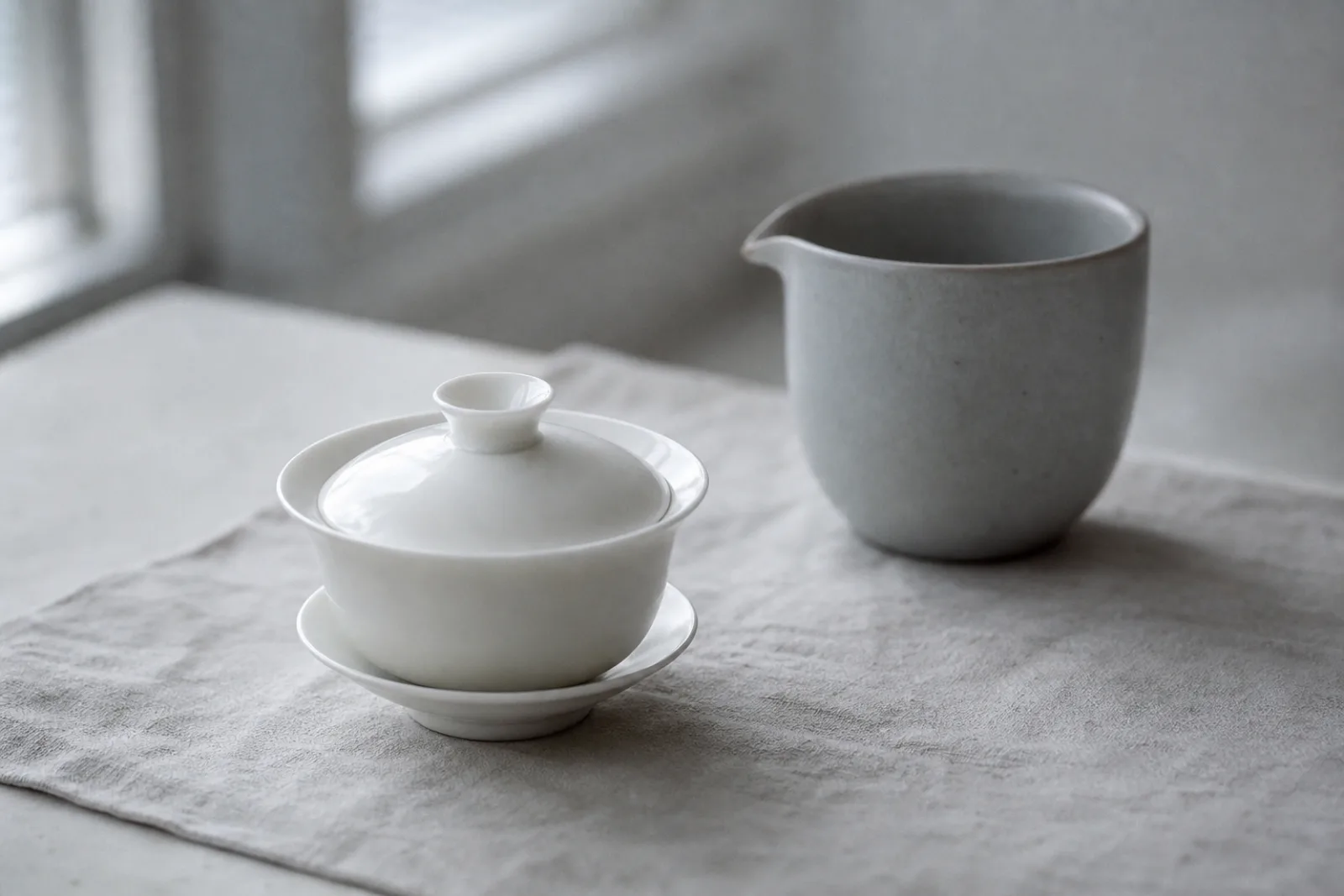
Jingdezhen white porcelain gaiwan, 90ml

*Jǐngdézhèn báicí gài wǎn*

景德镇白瓷盖碗

The most neutral vessel — 90ml white porcelain gaiwan from Jingdezhen, perfect for blind tasting and daily calibration.

$74USD · 105 g

Weight
105 g
Processing
High-fired porcelain (1300°C), glazed interior, unglazed foot rim.
Sourced by

Sourcing a blank slate — Michael Zhan visits Jingdezhen

This gaiwan came together on a humid April morning on the eastern outskirts of Jingdezhen, in a small workshop that still mixes its own kaolin body from nearby Gaoling village. Michael Zhan, our Procurement & Sourcing Specialist, had spent the previous week visiting seven different studios, carrying a notebook stuffed with side-by-side brewing logs. “We wanted a vessel that adds nothing and takes nothing away,” he recalled, holding one of the final test samples. “A gaiwan that stays completely out of the tea’s way.”

At each stop, he brewed the same lot of 2025 Bái Hóo Yín Zhēn and a lightly-roasted Tǐ Guān Yīn, tasting for any shift in texture or aftertaste. Most porcelain retained a faint clay minerality; a few rounded the liquor’s edges. The batch that became this product was the only one that delivered identical cups to the control (a laboratory-grade glass vessel). The potter, a second-generation artisan, fires his gaiwans at 1300°C for sixteen hours, achieving near-zero porosity with a tight, ringing tone when tapped.

Michael selected the 90ml size deliberately — large enough for a full aroma cup, small enough to hold in one hand without fatigue during long calibration sessions. The unglazed foot is a practical choice, providing grip even with wet fingers. Each gaiwan carries a minute variation in lid rock and rim thickness, a signature of hand-finishing that speaks to the craft rather than industrial uniformity.

The leaf, brewed

Neutral canvas — zero interference

dry leaf

Smooth, matte porcelain exterior contrasts a glossy interior. No residual scent or flavour from previous washes. The lid nests with a gentle, satisfying rock.

wet leaf

After a hot rinse, heat distributes evenly across the bowl. Glazed surfaces shed water cleanly — no beading, no staining.

liquor

The white body acts as a mirror for every tea hue. It offers no visual or thermal noise, making it ideal for calibration work.

aroma

The vessel itself holds no aroma; porcelain’s density ensures pure, unaltered fragrance from the tea alone.

taste

Completely neutral. Adds no body, astringency, or sweetness. Sits outside the tea’s character — a blank frame for the session.

finish

The unglazed foot gives a tactile reference point while pouring. The lid rim stays cool enough to handle through multiple short infusions.

Brewing

A method, not a recipe.

Method
gongfu
Ratio
1:15
Water temp
95
First infusion
10
Subsequent
5–7 infusions, adding 5 seconds each step

For blind tasting, use identical parameters across samples to isolate differences in tea character.

Sourced by

Michael Zhan

Procurement & Sourcing Specialist (China)

Full profile →