tea.equipment · sampling channel Encyclopedia · School · Atlas · Pu-erh · Equipment EN · RU · · · FR · ES · AR
tea.equipment Cart (0)

home · catalog

Gongfu teaware

Hand-painted porcelain gài wǎn from the kilns of Jingdezhen

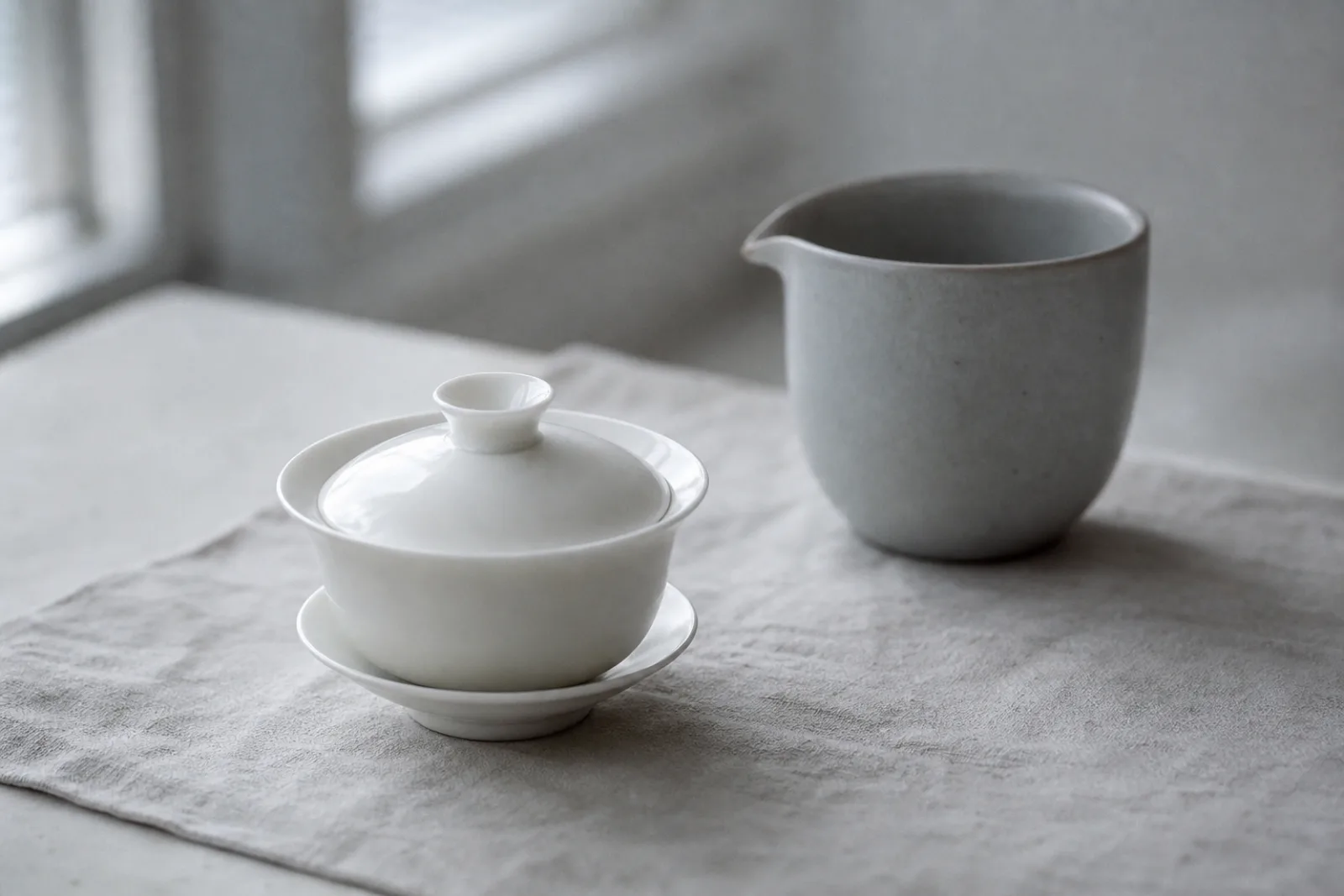
Porcelain gaiwans are the neutral heart of the gongfu ceremony — a canvas for the tea, unadulterated by clay or metal. From Jingdezhen’s centuries-old kilns, these three expressions marry function with the quiet beauty of hand-painted underglaze. Each sip is guided by the lid, each pour a small act of precision.

The art of the porcelain gaiwan

The gài wǎn (盖碗) — bowl, lid, and saucer — was refined in the Ming dynasty not merely as a drinking vessel, but as a complete brewing instrument. Jingdezhen, the porcelain capital, became its spiritual home. Unlike Yixing clay, which absorbs and shapes flavour through porosity, porcelain offers a pristine slate. Its vitreous, non-porous glaze preserves every nuance of the leaf, making it the darling of tea tasters and those who journey across tea families.

Our gaiwans are hand-thrown from Jingdezhen kaolin, fired at over 1300 °C to achieve a glassy, resonant body. The three styles in this collection — Qīng Huā Cí (blue-and-white), celadon, and pure white — each tell a different story of the craft. The cobalt blue drifts under a transparent glaze, unchanged for centuries; the celadon’s jade-green translucency hints at iron in the clay; the white porcelain stands as an exercise in purity, every brushstroke of the artisan suspended in stillness.

When you nestle a gaiwan in your palm, thumb and middle finger on the saucer, index finger balancing the knob, you feel a lineage. The gentle chime of porcelain, the controlled cascade through the seam between lid and bowl — these sensory details are as essential to gongfu as the tea itself. For a deeper dive into technique, our course ‘Gongfu Brewing from Bowl to Pitcher’ on tea.school walks you through the classic hold, temperatures, and the art of the pour.

A porcelain gaiwan asks nothing of the tea except its truth. It is the minimalist’s brew tool, the collector’s daily ritual, and the perfect entry point for anyone discovering the ceremony of Chinese tea.

Three expressions of Jingdezhen porcelain

From the classic blue-and-white dragon to a celadon so pale it holds light, each gaiwan in this season’s selection reflects a different facet of Jingdezhen’s artistry. Choose the one that speaks to your tea practice.
A buyer's note

How to choose your porcelain gaiwan

Watch the thickness

Thinner walls dissipate heat quicker, perfect for delicate green and white teas. A slightly thicker body retains warmth for rolled oolongs and dark teas.

Test the lid fit

The lid should seat snugly without wobbling, yet lift effortlessly. A loose lid makes pouring spill; a tight one frustrates the pour.

Pour check the seam

The gap between lid and bowl must be even. A well‑crafted gaiwan guides liquid in a clean, silent arc — no dribbles down the side.

Find your hold

Porcelain gets hot. Look for a flared rim or a wide saucer that allows the classic three‑finger grip. Practice with cold water until the motion becomes muscle memory.

Underglaze vs overglaze

Blue‑and‑white is true underglaze — the motif sits beneath a clear coat, making it durable and dishwasher‑safe. Some celadon and painted details are overglaze; hand‑wash to preserve the lustre.

Match capacity to ritual

A 90–110 ml gaiwan is ideal for solo gongfu, giving six to eight steepings from 5 g of tea. Go smaller for a quick *chá zhōng* or larger if you often share with a companion.

Common questions

Asked, answered.

Why choose a porcelain gaiwan over Yixing clay?

Porcelain is neutral and non-porous. It won’t absorb flavours, so you can taste each tea unaltered and switch between styles without ghosting.

Can I use a gaiwan for green, oolong, and black tea?

Yes — it’s the most versatile brewing vessel. Adjust water temperature and pour speed; the material works with everything from delicate white buds to roasted wulong.

How do I avoid burning my fingers?

Use the traditional grip: saucer in the left palm, right thumb and middle finger on the saucer edge, index finger pressing the lid knob. The bowl never touches your skin.

Will the hand‑painted decoration fade?

Underglaze motifs like the blue‑and‑white are fired at high temperature and won’t fade. Overglaze or gold‑decorated wares should be washed by hand to keep their vibrancy.

Why is Jingdezhen porcelain special?

Its unique kaolin clay and 1300 °C firing produce a dense, vitreous body with a clear ring. This thermal mass holds heat evenly and enhances the tactile experience.

What is the best capacity for one person?

90–110 ml gives you enough tea for multiple infusions without wasting leaf. A full round with 5 g of oolong yields about 8–10 steeps.

How do I clean a porcelain gaiwan?

Rinse with warm water and a soft cloth. Avoid soap on unglazed surfaces. The glazed interior is non‑absorbent, so it won’t hold stains.

Does a gaiwan need to be pre‑heated?

Yes — pour hot water in and out before adding leaves. This warms the porcelain, helping the tea open correctly and protecting the piece from thermal shock.