tea.equipment · sampling channel Encyclopedia · School · Atlas · Pu-erh · Equipment EN · RU · · · FR · ES · AR
tea.equipment Cart (0)
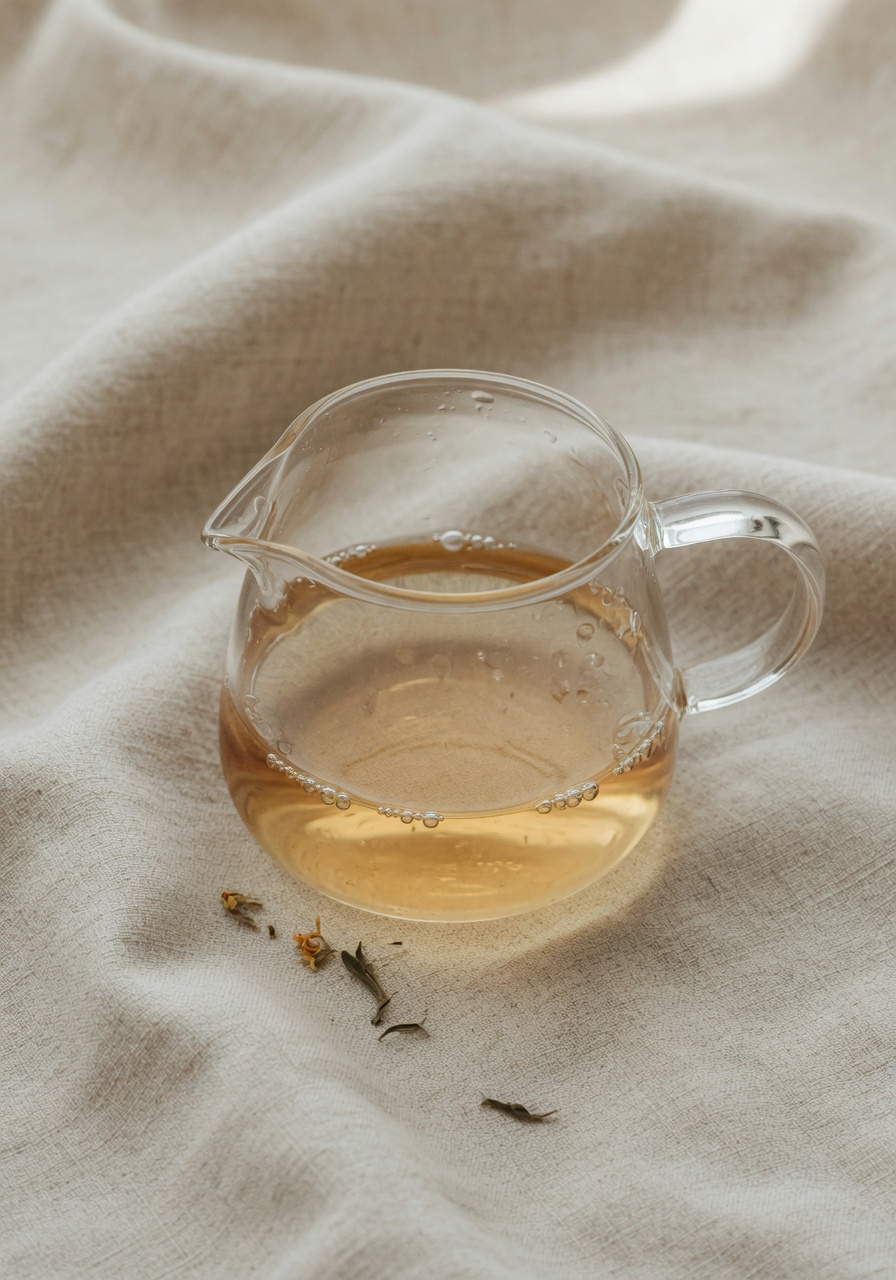
Cha hai glass pitcher, 150ml
dry
wet
liquor
plantation

home · accessories

Accessories — Brewing accessories

Cha hai glass pitcher, 150ml

Chá Hǎi

茶海

A hand-blown borosilicate fairness pitcher sized to pour a full 90ml gaiwan with headroom — clean walls, weighted base, no drip.

$41USD · 165 g

Weight
165 g
Harvest
Workshop run, Spring 2025
Processing
Hand-blown borosilicate, lamp-finished spout, annealed for thermal shock to 120°C
Sourced by

Liuzhou workshop, sized to the 90ml gaiwan

Michael sourced this pitcher line during a Fujian-to-Guangxi swing in early 2025, after a long-running complaint from our tasting room: most 200ml cha hai sit half-empty after a gaiwan pour, and the wide bowl drops temperature fast. He wanted 150ml — enough headroom for a full 90ml gaiwan, no more — and a spout that would not drip onto the tea boat.

The workshop belongs to Gao Lihua, a second-generation lampworker outside Liuzhou. Her studio supplies the same borosilicate line we carry on tea.glass, and she runs small batches of 40–60 pieces at a time, finishing each spout by hand at the bench torch. Michael sat through two pours of Mí Lán Xiāng (蜜兰香) with three prototype spouts before settling on the current cut — a slightly downturned lip that breaks the stream clean.

The glass itself is 3.3 expansion borosilicate, the same family used in laboratory ware. It anneals overnight in a small electric kiln, which is what gives the base its slight weight and removes the stress lines you see on cheaper blown pitchers. Each piece carries a faint pontil mark on the underside — Gao does not polish it out, and we asked her not to. It is the only way to tell a hand-blown piece from a mold-finished one.

Michael’s field notes from that visit are filed under his Guangxi report on tea.travel.

The leaf, brewed

Not a tea — but it changes how you read one

dry leaf

Clear walls, ~2.2mm thickness, no visible seam. Faint kiln-bloom on the underside, polished out by hand.

wet leaf

After a hot rinse the glass holds heat for roughly 40 seconds — enough to pour three small cups without the liquor cooling past tasting temperature.

liquor

Reads liquor honestly: a Yunnan hong reads copper, a sheng reads pale gold, a roasted oolong reads burnt orange. No green cast.

aroma

Neutral. The pitcher itself carries no scent after the first wash, even after sustained use with roasted teas.

taste

Borosilicate is inert — no mineral lift, no muting. What leaves the gaiwan arrives at the cup unchanged. This is the point of a glass cha hai.

finish

Spout cuts cleanly at the lip. Tested across 30 pours, no drip back along the underside.

Brewing

A method, not a recipe.

Method
gongfu
Ratio
n/a — vessel
Water temp
up to 100
First infusion
n/a
Subsequent
Rated for daily gongfu use, indefinite lifespan with hand-washing.

Warm the pitcher with your gaiwan rinse — pouring 95°C liquor into a cold cha hai drops temperature by 6–8°C before it reaches the cups.

Sourced by

Michael Zhan

Procurement & Sourcing Specialist (China)

Full profile →